




Field sobriety tests are the balance, eye and attention exercises a New York officer asks you to do at the roadside, and the three standardized ones are the horizontal gaze nystagmus eye test, the walk-and-turn and the one-leg stand. Each is scored against a fixed list of clues from the National Highway Traffic Safety Administration, while other tests, such as reciting the alphabet or touching your nose, have no validated scoring behind them. The DWI Team, led by former Onondaga County prosecutor and Super Lawyers Top Rated DWI attorney Dennis J. Nave, compares the roadside video with those rules in DWI cases across all 62 New York counties, for a flat fee that starts with a free case analysis.
New York field sobriety tests at a glance
- Horizontal gaze nystagmus: six clues, three in each eye. Officers are trained to treat four or more as a sign your BAC is 0.08 or higher, a cutoff that sorted drivers correctly 88% of the time in NHTSA’s 1998 San Diego study.
- Walk-and-turn: nine heel-to-toe steps out and nine back, scored on eight clues. The cutoff is two clues, correct 79% of the time in the same study.
- One-leg stand: one foot held roughly six inches above the ground while you count for 30 seconds, scored on four clues. The cutoff is two clues, correct 83% of the time.
- Refusing: New York’s implied consent law covers chemical tests, so declining the roadside tests brings no license suspension or revocation. The prosecution can still tell the jury you declined.
- Miranda: police can ask you to do the tests, and use the results, without first reading you your rights.
We compare the video of your tests with the officer’s report.
Officers are trained to give each test the same way every time, with set instructions, a level surface and questions about medical problems first. Tell us what happened at the roadside, and we will tell you where the tests strayed from that training.
Get a Free Case Analysis → Or call (800) 570-1810, available 24/7 →Where the Tests Fit in a DWI Stop
NHTSA trains officers to look for impaired driving in three phases, and the field sobriety tests belong to the last of them.
- Vehicle in motion: the officer watches how you drive, decides whether to stop you and watches how you stop.
- Personal contact: at the window, the officer looks at your eyes and face, listens to your speech, notes any odor and watches how you handle your license and registration. Some officers also ask you to recite part of the alphabet or count backward at this stage.
- Pre-arrest screening: the officer asks you to step out of the car for the field sobriety tests and may ask you to blow into a handheld roadside breath tester. What the officer sees here decides whether you are arrested.
Everything gathered in these phases goes toward probable cause to arrest you. The chemical test that produces a BAC number comes after the arrest, usually at the station, and our page on breath test evidence in New York covers the rules for it. When an officer arrests you without probable cause, the arrest and the evidence that followed it can be challenged at a Dunaway hearing.
The Horizontal Gaze Nystagmus Test
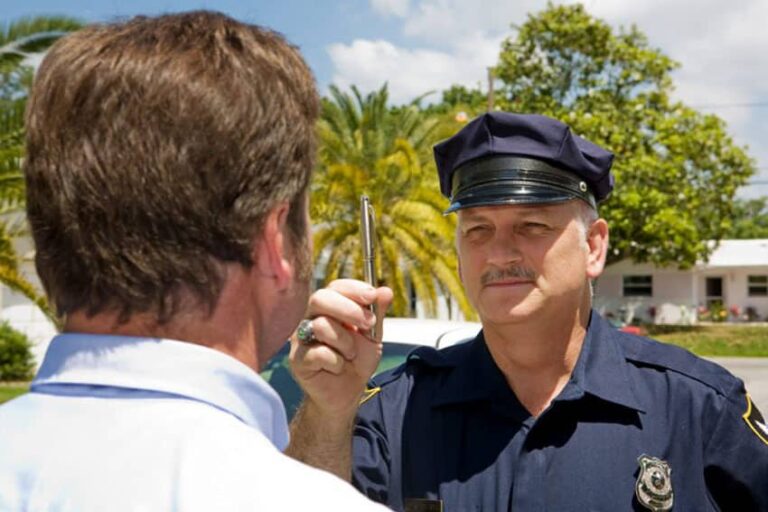
Nystagmus means the eye jerks on its own, outside your control. Alcohol and some other drugs make it appear sooner and more strongly as your eyes move to the side. The officer has you take off your glasses, holds a pen or penlight 12 to 15 inches from your nose, and tells you to follow it with your eyes while keeping your head still.
Before scoring anything, the officer is trained to check whether your pupils are the same size, whether your eyes jerk while you look straight ahead, and whether both eyes follow the pen together. The officer then looks for three clues in each eye:
- the eye moves in jerks as it follows the pen,
- the eye jerks distinctly when held as far to the side as it goes for at least four seconds, and
- the jerking starts before the eye has moved 45 degrees to the side.
Four or more of the six clues is the point at which officers are trained to treat your BAC as likely 0.08 or higher, and in NHTSA’s 1998 San Diego field study that cutoff sorted drivers correctly 88% of the time. Officers also check for vertical nystagmus by raising the pen and holding it for at least four seconds. Our article on the horizontal gaze nystagmus test covers the other causes of nystagmus and how the test is challenged.
The Walk-and-Turn Test
The walk-and-turn has two stages. In the instruction stage, you stand heel-to-toe on a real or imagined line with your arms at your sides while the officer explains and demonstrates the test. In the walking stage, you take nine heel-to-toe steps along the line, keep your front foot on the line while you turn with a series of short steps of your other foot, and take nine heel-to-toe steps back, counting each step out loud and watching your feet.
The officer scores eight clues:
- losing your balance during the instructions,
- starting before you are told to,
- stopping while walking,
- missing heel-to-toe,
- stepping so that one foot is entirely off the line,
- raising one or both arms more than 6 inches from your sides to keep your balance,
- turning improperly, and
- taking the wrong number of steps.
Two or more clues, or not finishing the test, is the training cutoff for a BAC of 0.08 or higher, and it sorted drivers correctly 79% of the time in the San Diego study. Our article on refusing the walk-and-turn and one-leg stand describes both tests in more detail.
The One-Leg Stand Test
You start with your heels together and your arms down by your sides, then raise one foot roughly six inches above the ground, keep it parallel to the ground, look at it, and count out loud by thousands, starting at one thousand one, until the officer tells you to stop. The officer times 30 seconds.
Four clues are scored: swaying while balancing, moving your arms 6 or more inches from your sides, hopping, and putting your foot down. Two or more is the training cutoff, and it sorted drivers correctly 83% of the time in the San Diego study. NHTSA’s manual tells officers that slight tremors of the foot or body should not be counted as swaying.
Where the Accuracy Figures Come From
The clue lists come from laboratory research the Southern California Research Institute did for NHTSA, which tested drivers against a BAC of 0.10. In that research, the eye test alone sorted people correctly 77% of the time, the walk-and-turn 68% and the one-leg stand 65%. Field studies followed in Colorado in 1995, Florida in 1997 and San Diego in 1998. San Diego tested the tests against the 0.08 limit, and officers who used all three made the correct arrest decision 91% of the time.
Those figures describe officers who gave the tests the standardized way. NHTSA’s own training says that conditions short of ideal, such as a roadside surface that is less than perfectly smooth, may affect how much weight a court gives the results. It also tells officers that a count of clues is enough for the arrest decision, while a conviction needs a description of exactly what you did on each test.
Non-Standardized Tests: Romberg, Finger-to-Nose, Finger Count, Alphabet and Counting Backward
NHTSA’s field sobriety training manual calls the eye test, the walk-and-turn and the one-leg stand the only standardized field sobriety tests for which validated clues have been identified. Officers also use other exercises:
- Alphabet: reciting part of the alphabet from a letter other than A to a letter other than Z, such as E to P. NHTSA teaches it as a question to ask at the car window.
- Counting backward: counting out loud 15 or more numbers in reverse order, starting and stopping on numbers that do not end in 0 or 5, such as 64 to 49.
- Finger count: touching the tip of your thumb to the tip of each finger while counting one to four, then reversing direction while counting four to one.
- Finger-to-nose: tilting your head back, closing your eyes and touching the tip of your nose with whichever index finger the officer calls out. New York State Parks police include it in the seated test battery they give boat operators.
- Modified Romberg balance: a balance test adapted from the one doctors use, done with your heels together and your eyes shut. The International Association of Chiefs of Police lists it as one of the four divided attention tests in a drug recognition expert’s 12-step evaluation, along with the walk-and-turn, the one-leg stand and finger-to-nose.
NHTSA’s field sobriety training gives these tests no clue lists or accuracy figures, so a report that relies on them rests on the officer’s description of what you did. A drug recognition expert gives the Romberg and finger-to-nose tests at the station when a driver’s impairment looks out of line with the breath result, and our page on DWAI-drugs in New York explains drug cases.
Seated Tests on the Water
Boat operators get a different set of tests. The New York State Parks form for the seated battery covers the eye test, finger-to-nose, a palm pat and a hand coordination exercise, each with its own clue list. In one of our cases, officers gave a personal watercraft operator near Alexandria Bay field sobriety tests using two moving boats, and despite a BAC of .23 he resolved the case with a plea to a single count of BWAI. Prior results do not guarantee a similar outcome. Our page on boating while intoxicated covers BWI charges.
Conditions That Affect How You Do
NHTSA trains officers to give the walk-and-turn and one-leg stand on a reasonably dry, hard, level and non-slippery surface, and to ask you first whether you have any physical problems or disabilities. Its manual says the original research found that people over 65 and people with back, leg or inner ear problems had difficulty with the walk-and-turn, and that fewer than 1.5% of the people tested in that research were over 65. Anyone wearing heels more than 2 inches high is supposed to be offered the chance to take them off.
The New York State Parks form starts with five questions: whether you have any physical defects or disabilities, whether you have any eye problems, whether you are sick or injured, whether you are under a doctor’s or dentist’s care, and whether you take any medication or drugs. Whether the officer asked questions like these, and what you answered, is something we look for in the report and on the video. If you have a knee, back, inner ear or neurological condition, tell the officer before any test begins.
In one of our cases, police put a combat veteran with an artificial leg through the walk-and-turn and one-leg stand. He resolved the DWI with a plea to a single traffic ticket for driving the wrong way on a one-way street, and our attorneys won his refusal hearing. Prior results do not guarantee a similar outcome.
Your Rights at the Roadside
New York’s implied consent law, VTL § 1194(2), covers chemical tests of your breath, blood, urine or saliva. The roadside performance tests fall outside it, so declining them brings no license suspension or revocation. Our article on refusing field sobriety tests in New York explains how to decline, and our page on implied consent covers the chemical test.
In People v. Berg, decided in 1999, a driver refused to recite the alphabet or do the eye test, the walk-and-turn and the one-leg stand, and the Court of Appeals allowed the prosecution to use that refusal at trial even though she had not received Miranda warnings. The court reasoned that the tests produce physical evidence and nothing forced her to refuse. It had already held in earlier cases that Miranda warnings are unnecessary before the test results are used.
The handheld breath tester follows a separate rule. Under VTL § 1194(1)(b), a driver who was in a crash or was driving in violation of the Vehicle and Traffic Law must take a breath test at the roadside when an officer asks, and if it shows alcohol, the officer may then ask for a chemical test. Our article on the portable breath test explains the device.
How We Review Field Sobriety Evidence
The prosecution has to turn over the dashcam and body camera video in discovery under CPL § 245.20. We watch each test against NHTSA’s instructions: what the officer said, whether the officer demonstrated, the surface, the lighting, your footwear and whether anyone asked about medical conditions. Then we compare the video with the clues in the officer’s report. Our article on whether field sobriety tests are admissible in court covers how the results are used at trial.
In People vs. DK, our attorneys raised doubts about the field sobriety tests and the client was acquitted. In People vs. RB, a client who was said to have failed the tests and blew a .08 was found not guilty of two felony DWI counts after a three-day jury trial. Prior results do not guarantee a similar outcome.
Every clue the officer wrote down has to match what the video shows.
The DWI Team reviews the stop, each roadside test and the arrest against the training the officer received, then explains your options before your first court date.
Talk With a DWI Lawyer About Your Roadside Tests
Call the DWI Team at (800) 570-1810, any time of day, or request a free case analysis. Our DWI defense attorneys work for a flat fee, with payment plans from $500 down, and will go through the video of your tests with you.
Frequently Asked Questions About Field Sobriety Tests in New York
What are the three field sobriety tests in New York?
The three standardized field sobriety tests are the horizontal gaze nystagmus eye test, the walk-and-turn and the one-leg stand. They come from NHTSA’s training, and they are the only roadside tests with validated clue lists.
Are field sobriety tests mandatory in New York?
You can refuse them without losing your license. New York’s implied consent law applies to chemical tests of breath, blood, urine or saliva, so refusing the roadside performance tests brings no license suspension or revocation. The prosecution can still tell the jury that you refused, and the officer can arrest you based on other observations.
How accurate are field sobriety tests?
In NHTSA’s 1998 San Diego field study, the training cutoffs sorted drivers correctly at a BAC of 0.08 or above 88% of the time for the eye test, 79% for the walk-and-turn and 83% for the one-leg stand. Those figures assume the officer gave each test the standardized way.
Can a sober person fail a field sobriety test?
A sober person can fail. NHTSA’s original research found that people over 65 and people with back, leg or inner ear problems had difficulty with the walk-and-turn, and the accuracy figures leave a share of drivers sorted incorrectly. The surface, your footwear, nerves and medical conditions can all affect how you do.
What is the modified Romberg test?
The modified Romberg balance test checks your balance with your heels together and your eyes shut. Drug recognition experts use it as one of four divided attention tests in a drug evaluation, and NHTSA’s field sobriety training gives it no validated clue list.
Can refusing field sobriety tests be used against me in New York?
The prosecution can tell the jury about it. In People v. Berg (1999), the Court of Appeals held that a driver’s refusal to perform field sobriety tests can be used at trial even without Miranda warnings. Refusing the tests still brings no license penalty.
How many clues fail the walk-and-turn test?
Two of the eight clues, or not finishing the test, is the point at which officers are trained to treat your BAC as likely 0.08 or above.
This page explains New York law in general terms and is not legal advice for your situation. Every case turns on its own facts. Contact the DWI Team to talk with an attorney.