




An ignition interlock in New York costs about $100 a month plus roughly $200 to install and remove, and every DWI or aggravated DWI conviction requires one in each vehicle you own or drive for at least 12 months, or for six months once you prove it was installed and maintained. You pay for it yourself unless the judge finds you cannot afford it and orders a payment plan or waives the fees. The DWI Team, led by former Onondaga County prosecutor and Super Lawyers Top Rated DWI attorney Dennis J. Nave, handles interlock sentences and the pleas that avoid them in all 62 New York counties, for a flat fee that starts with a free case analysis.
Ignition interlock in New York at a glance
- Who: anyone convicted of DWI, aggravated DWI, or a crime that includes an alcohol DWI, such as vehicular assault.
- How long: at least 12 months, ending after six months with proof the device was installed and maintained, unless the judge orders a longer period.
- Deadline: installed within 10 business days of sentencing, with proof to the court and your monitor within 3 business days.
- Cost: about $200 to install and remove plus about $100 a month for each vehicle, paid by you unless the court finds you unable to afford it.
- Service: a visit to the installer every 30 days, or every 60 days for a device that reports its data on its own.
- Driving without one: a Class A misdemeanor, with up to a year in jail.
Who Has to Install an Ignition Interlock in New York
Under VTL § 1198(2)(a) and Penal Law § 60.21, a judge sentencing anyone for a DWI under VTL § 1192(2), (2-a) or (3) must impose probation or a conditional discharge and order an ignition interlock in every vehicle the person owns or operates. That covers a first offense DWI, aggravated DWI at a BAC of 0.18 or higher, a DWI with a child in the car under Leandra’s Law, every felony DWI, and crimes built on an alcohol DWI, vehicular assault among them. The requirement applies even if you also serve jail time, because the probation or conditional discharge starts when you are released.
A conviction for driving while ability impaired under VTL § 1192(1) is a traffic infraction, and the interlock law does not list it, so a DWAI by alcohol carries no interlock requirement. A judge can also order the device before sentencing, as a condition of release while the case is pending, and that time counts toward the interlock period.
A second DWI within five years brings a longer order. Under VTL § 1193(1-a), the device stays installed for the whole license revocation and for an added period the judge sets after it ends. The DMV can also require an interlock as a condition of returning a license to a driver with several alcohol convictions, under rules it adopted in 2012, separately from any court order.
How Long the Interlock Stays On
The order lasts at least 12 months. Under VTL § 1193(1)(b)(ii), the restriction ends early once you show the device has been in your car and working for at least six months, unless the sentence sets a longer one. The clock starts on the day of sentencing, or on the earlier day the device went in if you had it put in before sentencing. The New York courts’ interlock guide puts it plainly: the sooner you install, the sooner your time starts to run.
A judge can keep the device on for as long as the sentence lasts. Probation for a misdemeanor DWI runs two or three years and for a felony three to five years, and a conditional discharge runs one year for a misdemeanor and three years for a felony. After violations, a monitor can ask the court for more time on the device, so the six-month end date applies only to drivers with a clean record on the device. Broome County’s STOP-DWI program, for example, approves early removal after six months only when the driver had no violation that led to a court-ordered extension.
When the period ends, your monitor tells the DMV electronically, and you can then apply for a new license document without the restriction, according to the DMV’s Leandra’s Law page. The interlock restriction appears on the back of the license as “interlock device” and is added to your record even while the license is revoked.
What an Ignition Interlock Costs in New York
The New York courts estimate about $200 for installation and removal plus about $100 for each month the device is in the car. At those figures, the 12-month minimum comes to about $1,400 for one vehicle, and a restriction that ends at six months comes to about $800. Every vehicle you own or drive needs its own device, so a second car doubles the monthly bill.
Four manufacturers are approved to supply devices in New York: Intoxalock, LifeSafer, RoadGuard (formerly Dräger) and Smart Start. Each one charges within a maximum fee schedule approved by the state Division of Criminal Justice Services, and three of them posted these New York prices on November 19, 2026:
| Company | Install | Monthly |
|---|---|---|
| Intoxalock | Not listed | $95 to $125 |
| Smart Start | From $150 | From $104.94 |
| LifeSafer | $100 to $150 | $2.50 to $3.50 a day |
Each company also charges to remove the device at the end, and Smart Start lists a one-time enrollment fee and calibration visits starting at $25.
The device class your monitor assigns also affects the price. Under the state’s interlock program, a Class I device takes a photo of whoever blows into it, a Class II device also tracks the car by GPS and sends results as they happen, and a Class III device can alert an emergency response program when a driver fails a test on the road. The probation department picks the class for a driver on probation, the monitor picks it for a conditional discharge, and you choose the manufacturer and model within that class. Of the 2,346 devices installed statewide in 2024, 1,943 were Class II.
The interlock cost comes on top of the fine, the state surcharge and the other costs of a DWI under VTL § 1198(5)(a). Our page on a first offense DWI in New York lists those amounts. Outages can also leave you unable to drive: our article on the Intoxalock cyberattack covers drivers who could not start their cars when the manufacturer’s systems went down.
The best time to deal with the interlock is before sentencing.
A fee waiver is best requested before you are sentenced, and a plea to DWAI carries no interlock at all. The DWI Team can review the charges and the paperwork with you now.
Get a Free Case Analysis → Or call (800) 570-1810, available 24/7 →If You Cannot Afford It: Payment Plans and Fee Waivers
Under VTL § 1198(5)(a), you pay for the device unless the court decides you cannot afford it. In that case the judge can set up a payment plan or cancel the fees, and when the fees are cancelled, the manufacturer has to supply the device at no charge. The judge decides from the state’s Interlock Financial Disclosure Report, form DCJS-OPCA-500IID-FDR, which lists your income from all sources, your assets and your expenses.
State rules call for three copies of that report to be filed with the criminal court before sentencing, or before any release that carries an interlock condition, and the court shares it with the prosecutor and your lawyer. The courts’ guide tells drivers who have already been sentenced to file it with the sentencing court as soon as possible, because the 10-day installation deadline keeps running. A waiver covers the cost of the device and leaves the interlock requirement itself in place. In 2024, judges waived the fees for 164 of the 2,346 devices installed statewide, about 7 percent, and ordered a payment plan for 122 more.
In some counties the monitor then chooses the company. Broome County’s interlock instructions tell drivers granted a waiver to call the STOP-DWI office, which assigns the installer.
Installing the Device: Deadlines and What to Bring
State rules give you 10 business days from the day the court imposes the condition to have a device installed in every vehicle you own or operate. If you are sentenced to jail, the 10 days start when you are released. Within 3 business days of the installation, you have to give proof of it to the court and to your monitor.
Your monitor gives you a list of installers, and the state publishes every installation and service location. The installer and the monitor need:
- a copy of the court order and conditions that require the interlock,
- photo identification,
- the name and policy number of your car insurance,
- the vehicle identification number of every vehicle you own or routinely drive, and the names of everyone else who drives them, and
- a notarized statement from the owner allowing the installation, if the car is registered to someone else.
Broome County tells drivers to plan for an installation that can take three to four hours and to bring everyone who will drive the car, so the installer can show each of them how the device works.
Who Monitors Your Interlock
If you are on probation, the county probation department monitors the device. For a conditional discharge, each county’s plan names the monitor, which can be the probation department, the STOP-DWI program or the district attorney. In the counties where the DWI Team has offices, the state’s January 2026 list names these monitors for conditional discharge cases:
| County | DWI Team office | Conditional discharge monitor |
|---|---|---|
| Onondaga | Syracuse | Onondaga County STOP-DWI Program |
| Albany | Albany | Albany County Probation |
| Monroe | Rochester | Monroe County Probation |
| Erie | Buffalo | Erie County Central Police Services STOP-DWI |
| Broome | Binghamton | Broome County STOP-DWI Program |
| Oneida | Utica and Rome | Oneida County Probation and District Attorney |
| Jefferson | Watertown | Jefferson County Probation |
| Saratoga | Saratoga Springs | Saratoga County Probation |
| Ulster | Kingston | Ulster County Probation and STOP-DWI |
| Rockland | New City | Rockland County Probation |
Using the Interlock Every Day
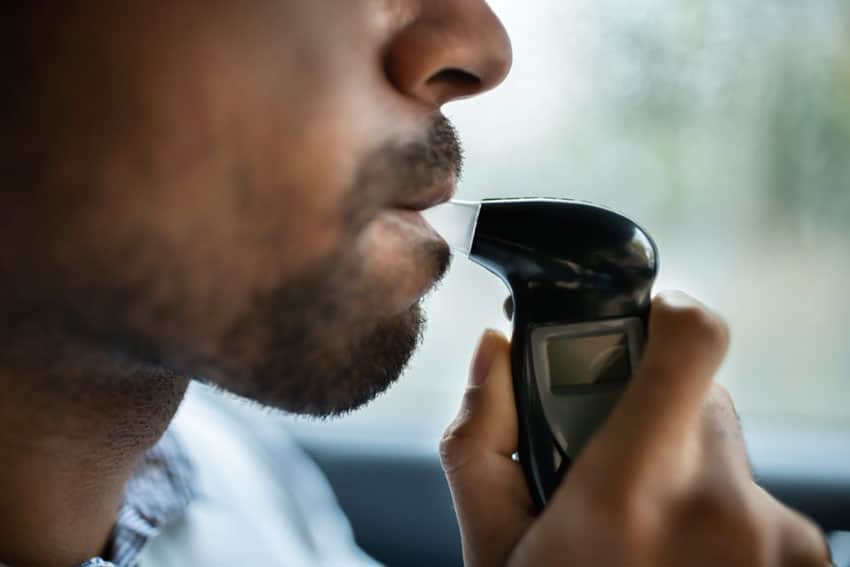
You blow into the device before the engine will start. New York devices are set to block the start at a BAC of 0.025, well under the 0.08 legal limit, and they photograph the driver at every test. If a start-up test fails, the device asks for a retest within 5 to 15 minutes.
Once you are driving, the device asks for a rolling test 5 to 15 minutes into the trip and then at random times no more than 30 minutes apart. After a failed or missed rolling test, it asks again within one to three minutes, and if you still do not give a clean sample, the horn sounds or an alarm goes off until you turn the engine off or pass the test.
You also have to bring the car in for service. The first visit is due 30 days after installation, and later visits come every 30 days, or every 60 days for a device that sends its data to the monitor on its own. At each visit the installer downloads the record and recalibrates the device as needed.
Lockouts
The device goes into lockout mode after one failed or missed start-up retest, one failed or missed rolling retest, or one missed service visit. The manufacturer can issue an unlock code, and once it does, you have two hours to get to a service appointment.
Products That Can Set It Off
Alcohol left in your mouth can register on the device even when your blood alcohol is far lower, the same mouth alcohol problem our page on breath test evidence explains. Broome County’s instructions warn drivers about mouthwash, some toothpastes, hand sanitizer, cologne and aerosol sprays in the car, “alcohol-free” beer and wine, cough syrup and asthma inhalers, and foods made with vanilla extract, wine vinegar or soy sauce. The same instructions advise waiting 15 minutes after eating or drinking anything before you blow.
A driver with a medical condition that makes a full breath sample hard can ask for a smaller one. State rules let the manufacturer accept a reduced sample of 1.2 liters in place of 1.5 when a physician documents the condition.
Failed Tests, Lockouts and Other Violations
The device keeps a record of every start, every test result and how long the car was driven. Your monitor has to report to the court and the district attorney when:
- the device was never installed in a vehicle you own or drive,
- you miss a service visit and do not have the car serviced within three business days,
- anyone tampers with or tries to get around the device,
- the device goes into lockout, or
- a test or retest shows a BAC of 0.05 or higher.
After a report, the monitor can recommend a longer interlock period, alcohol treatment or the Drinking Driver Program, a referral to the DMV, or revocation of the sentence. Under VTL § 1198(4)(a), a judge can revoke or change the probation or conditional discharge of anyone who fails to prove the device was installed, unless the court finds good cause.
Some violations are new crimes. Getting another person to give the breath sample or start the engine for you, giving a sample for a restricted driver, tampering with the device, and driving without it each count as a Class A misdemeanor under VTL § 1198(9), with up to a year in jail. Our pages on circumvention of an interlock and driving a vehicle without an interlock explain those charges.
Rentals, Borrowed Cars and Work Vehicles
The restriction follows you into every car you drive, rentals, leased cars and borrowed cars included, under VTL § 1198(7). You have to tell anyone who rents, leases or lends you a car about the restriction, and knowingly lending or renting an unequipped car to someone under an interlock order is itself a misdemeanor, covered on our page about renting a vehicle without an interlock.
A work vehicle is the one exception. Under VTL § 1198(8), you can drive your employer’s vehicle without a device, during work and for work only, after your employer has been told about the restriction and has given written permission that you file with the court and the probation department. You also have to tell the court and the probation department that you plan to drive it. A vehicle owned by a company you own or control, even in part, needs a device like any other car.
The interlock gives you no right to drive while your license is revoked. A DWI conviction revokes the license for at least six months, and after the minimum revocation the DMV can issue a post-revocation conditional license limited to cars with an interlock, for trips such as work, school, probation and medical appointments. Our guide to your New York driver’s license after a DWI covers those licenses.
If You Have No Car
A driver with no car can meet the order without a device. Under VTL § 1198(4)(a), the court can accept your sworn statement that you own no vehicle and will stay off the road for the whole interlock period as good cause for skipping the installation. The restriction then stays on your license for the full length of the sentence, because the six-month end date requires proof that a device was installed and maintained.
Broome County checks DMV title and registration records and counts any vehicle in your name as yours, whoever drives it. If you buy or register a car later, you have to tell the court and the monitor and have a device installed. In 2024, monitors statewide received 9,663 court orders for an interlock and recorded an installation within the same quarter for 2,346 of them, about 24 percent.
Avoiding the Interlock Requirement
The interlock comes with a DWI conviction, so a dismissal, an acquittal or a plea to DWAI under VTL § 1192(1) avoids it. Whether a DWAI reduction is available depends on the evidence and on the county district attorney’s policy, which in some counties rules out a reduction at a BAC of 0.18 or higher. Our article on DWI plea bargaining explains how reductions work.
In one of our cases, a client charged with DWI and aggravated DWI at an alleged BAC of 0.21 was first offered a plea to misdemeanor DWI with the maximum fines and the ignition interlock. We kept negotiating, and the client pleaded to the non-criminal offense of DWAI in full satisfaction of the charges, with no interlock. In another case, a client charged with aggravated DWI who needed to keep driving for work avoided the interlock with a DWAI plea after we showed the prosecutor his treatment and his volunteer work. Prior results do not guarantee a similar outcome.
Deal with the interlock before you are sentenced.
The DWI Team can challenge the DWI charge, negotiate a plea that carries no interlock, and file the fee waiver before sentencing when the device cannot be avoided.
Call the DWI Team at (800) 570-1810, any time of day, or request a free case analysis. Our DWI defense attorneys work for a flat fee, with payment plans from $500 down, and can tell you whether an interlock applies to your case and how long it would last.
Frequently Asked Questions About Ignition Interlocks in New York
How much does an ignition interlock cost in New York?
The New York courts estimate about $200 for installation and removal plus about $100 a month, or about $1,400 for a 12-month order on one vehicle. Manufacturers’ published New York prices run from $95 to $125 a month at Intoxalock and from $104.94 a month at Smart Start.
How long do you need an ignition interlock in New York?
The order lasts at least 12 months after a DWI conviction and ends after six months for a driver who shows the device was in the car and working that long, unless the sentence sets a longer period. Time with a device put in before sentencing also counts.
Who has to install an ignition interlock in New York?
Every driver convicted of DWI, aggravated DWI, or a crime that includes an alcohol DWI needs a device in each vehicle they own or drive. DWAI by alcohol, a traffic infraction, carries no interlock requirement.
Can I get my interlock off early in New York?
Yes. Six months with a working device in the car ends the restriction unless the sentence sets a longer period, and violations can add time.
What if I can’t afford the ignition interlock device?
File the state’s Interlock Financial Disclosure Report with the court, ideally before sentencing. A judge who finds you unable to pay can set up a payment plan or cancel the fees, and the interlock requirement itself stays in place.
What if I don’t own a car but have to install an interlock?
You can swear that you own no vehicle and will stay off the road for the whole interlock period, and the court can accept that as good cause for skipping the installation. The restriction then stays on your license for the full length of your sentence.
Will one drink set off an ignition interlock?
It can. New York devices block the engine at a BAC of 0.025, and alcohol left in the mouth from a drink, mouthwash or food can register, so county monitors advise waiting 15 minutes after eating or drinking anything before you blow.
Can someone else drive my car with an interlock?
Yes, but every driver has to pass the same breath tests, and the device photographs whoever takes each test. You must give the installer and the monitor the names of everyone who drives the car, and blowing into the device so that a restricted driver can drive is a Class A misdemeanor.
This page explains New York law in general terms and is not legal advice for your situation. Every case turns on its own facts. Contact the DWI Team to talk with an attorney.